

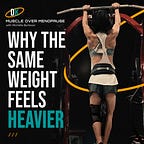


Some days the dumbbells haven’t changed, but your access to strength has. Sleep loss and mental fatigue slow the lifts, raise perceived effort, and make an ordinary session cost more than it should.
I’m talking what grief, heartbreak, and four hours of sleep metabolically do inside a workout, and how to adjust the training without turning one bad week into a verdict on your body.
Get inside the Training Lab: https://deepkimchi.substack.com/subscribe
In this episode:
What happened to ten resistance-trained women held to five hours in bed for nine nights
Why lower-body lifts moved up to 15 percent slower while the logbook still looked normal
Total training distress rose 84 percent on almost identical total work
How mental fatigue cuts training volume, and which lifts take the bigger hit
A scaled warm-up that tells you what kind of mood your muscles are in: 60 percent for ten, 80 for five, 90 for two
When to drop the load, swap to the leg press, and go home after thirty useful minutes
Why “easy, right, or too hard” needs an honest answer the week your life is on fire
Why the mood benefit showed up without notable strength gains
The way to get over somebody is to get under some iron
The warm-up is data, not character evidence.
Clinical depression deserves clinical care. Resistance training can support treatment. It cannot replace a qualified clinician, medication, therapy, or immediate help when you cannot care for yourself. A training plan is not crisis care.
If one woman came to mind while you were listening, send her this episode. She may not need a pep talk. She may need a place to put her body for a while.
Training Lab
The Lab asks how every set felt: easy, right, or too hard. Your program adjusts from that answer, which matters most on the weeks you can’t trust your own read on things. Six programs, autoregulated, built for bodies with mileage.
Get inside the Training Lab:

Resources:
Knowles O, et al. “Sustained Sleep Restriction Reduces Resistance Exercise Quality and Quantity in Females.” SportRxiv. https://doi.org/10.51224/SRXIV.157
Solon-Júnior LJF, et al. “Mental Fatigue and Resistance Exercise: A Systematic Review and Meta-Analysis Including GRADE Qualification.” European Journal of Sport Science, 2026. https://pubmed.ncbi.nlm.nih.gov/42168782/
Gordon BR, et al. “Association of Efficacy of Resistance Exercise Training With Depressive Symptoms.” JAMA Psychiatry, 2018. https://pubmed.ncbi.nlm.nih.gov/29800984/
Agudelo LZ, et al. “Skeletal Muscle PGC-1α1 Modulates Kynurenine Metabolism and Mediates Resilience to Stress-Induced Depression.” Cell, 2014. https://pubmed.ncbi.nlm.nih.gov/25259918/
Every paid subscription supports Save Our Paws, the Romanian rescue pulling dogs and cats off the street and into warm laps. Strong women, saved animals. That’s the deal.


